德英生物科技

Climate-Related Disclosures

Status of Climate-Related Information Implementation

TCFD

Item Implementation Status
1. Describe how the Board of Directors and management oversee and govern climate-related risks and opportunities. 1. The Board of Directors has established the “Sustainability Report Promotion Committee”, chaired by the President. Based on actual work needs, the committee oversees areas such as ethical business practices, intellectual property rights, new drug R&D and innovation management, carbon emissions and climate action, energy management, waste management, diversity and inclusion (workplace diversity and equal opportunity), talent development and training, public welfare activities, social participation and learning, etc. The “Sustainability Report Promotion Committee” is responsible for submitting annual plans and implementation results to the Board of Directors.
2. Describe how identified climate risks and opportunities affect the company’s business, strategy and financial performance (short, medium and long term). 2. Business: In the short term, the impact on the company is limited. In the medium to long term, adjustments will be made as necessary based on customer requirements. Changes in supply–demand structures and product/service mechanisms may affect markets in complex ways and will be adjusted according to actual circumstances.
Strategy: Limit any activities that may exacerbate adverse climate change impacts and promote climate change adaptation.
Financial: In the short term, increased operating costs may arise from higher electricity prices and replacement of energy-saving equipment; in the medium to long term, existing assets may face impairment or early retirement, and government carbon fee policies may also have an impact.
Response measures: Plants must enhance energy efficiency of equipment and introduce energy-saving devices. The purchase or repair of plant equipment will increase capital expenditures. In line with customer requirements, the company will also strengthen activities related to green procurement of raw materials.
3. Describe the financial impacts of extreme climate events and transition actions. 3. Extreme climate events: May result in asset damage or supply chain disruption.
Transition actions: Gradual transition towards supporting low-carbon, high-efficiency technological improvements and innovation may affect the organization’s competitiveness and increase production and distribution costs.
4. Describe how climate risk identification, assessment and management processes are integrated into the overall risk management system. 4. The purpose of identifying climate change risks is not to make precise predictions, but to regularly monitor relevant laws, guidelines and literature to enhance the completeness of risk identification, explore and understand potential major risks, and thereby strengthen risk identification and measurement for business decision-making.
The company assesses potential risks and opportunities that climate change may bring and incorporates climate-related factors into business strategy planning and decision processes. These are included in the overall risk management policy. The company actively promotes various environmental protection and energy-saving, carbon-reduction measures, reduces greenhouse gas emissions and promotes green services to mitigate and adapt to the operational impacts caused by climate change. It complies with relevant government regulations, continuously improves climate change management, discloses climate-related information and refines climate-related strategies and management to respond to external environmental changes.
5. If scenario analysis is used to assess resilience to climate change risks, describe the scenarios, parameters, assumptions, analytical factors and key financial impacts used. 5. Mild scenario: Low-emission scenario where temperature rise does not exceed 2°C; warming is controlled and physical risks are relatively low.
Severe scenario: High-emission scenario where temperature rise does not exceed 4°C.
Scenario analysis (including 2°C or more stringent scenarios):
As a result of climate change, extreme weather events are occurring more frequently. Equipment may suffer flood damage due to heavy rainfall or typhoons, affecting shipment schedules and causing property losses. Taking into account the future probability of flooding, the company evaluates the level of flood risk it faces and plans various flood control measures accordingly, including installing flood gates and purchasing pumps to prevent flood-induced asset losses.
6. If there are transition plans for managing climate-related risks, describe the plan content and the metrics and targets used to identify and manage physical and transition risks. 6. Response actions:
Transition risks are addressed mainly in response to the requirements of ISO 14064-1.
For physical risks: “Annual wind- and rain-related disasters caused by climate change” and “Each unit implements preparation work, response measures and patrol inspections in accordance with typhoon conditions and responsibilities.”
7. If internal carbon pricing is used as a planning tool, explain the basis for determining the price. 7. The company has not yet planned an internal carbon pricing mechanism. In addition to awaiting further confirmation of greenhouse gas-related regulations or guidelines from government agencies, it plans to conduct its own inventory and implement reduction measures.
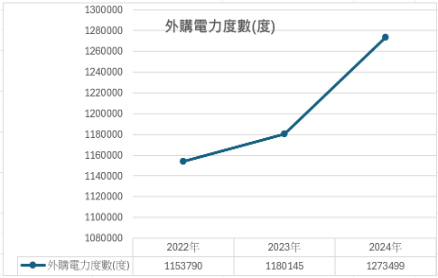
8. If climate-related targets are set, explain the activities and emission scopes covered, the planning period, annual progress, and, if carbon offsets or renewable energy certificates (RECs) are used to achieve targets, describe the source and quantity of offsets or number of RECs. 8. Short-term target: Average annual electricity-saving rate of 1%.
Medium-term target: Average annual electricity-saving rate of 1%.
Long-term target: In line with government policies, achieve maximum energy efficiency and continue to promote various environmental protection programs.
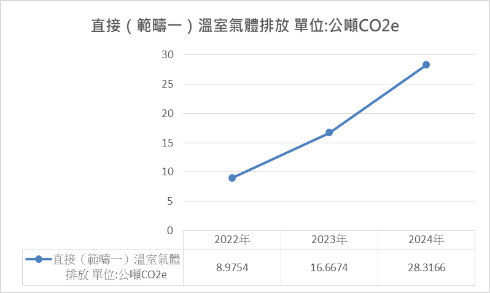
9. Status of greenhouse gas inventory and assurance. 9. Greenhouse gas inventory for the past three years:
2022: 596.2545 metric tons CO2e
2023: 600.8392 metric tons CO2e
2024: 657.4250 metric tons CO2e
Tip: On mobile or small screens, you can scroll this table horizontally.

Greenhouse Gas Inventory Information

Item Content
Emission volume and intensity for the most recent two years and coverage
2023 emissions (Scope 1 + 2) 600.8392 metric tons CO2e
2024 emissions (Scope 1 + 2) 657.4250 metric tons CO2e
Emission intensity
2023 emission intensity 0.0033 (metric tons CO2e/thousand NT$)
2024 emission intensity 0.0026 (metric tons CO2e/thousand NT$)
Data coverage Head Office: No. 92, Keji 5th Rd., Mazhugong Village, Annan Dist., Tainan City; Southern Taiwan Science Park Plant: 4F, No. 26, Ln. 31, Sec. 1, Huandong Rd., Fenghua Village, Xinshi Dist., Tainan City
Tip: You can scroll this table horizontally.

Greenhouse Gas Assurance Information

Item Content
Assurance status (scope/institution/criteria/opinion)
Assurance scope Head Office: No. 92, Keji 5th Rd., Mazhugong Village, Annan Dist., Tainan City; Southern Taiwan Science Park Plant: 4F, No. 26, Ln. 31, Sec. 1, Huandong Rd., Fenghua Village, Xinshi Dist., Tainan City
Assurance institution Not yet assured
Assurance criteria N/A
Assurance opinion N/A
Tip: You can scroll this table horizontally.

Greenhouse Gas Reduction Targets, Strategies and Action Plans

Item Content
Base year and data for reduction 2024: 657.4250 metric tons CO2e (Scope 1 + Scope 2)
Reduction target Electricity-saving rate of 1%
Strategies and specific actions 1. Adjust elevator standby/sleep time (continuously monitor energy consumption and report results in 2025)
2. Continue replacement of LED lighting throughout the plant (continuously monitor energy consumption and report results in 2025)
Progress towards target achievement Electricity-saving rate reached 1% in 2024
Tip: You can scroll this table horizontally.